
Search
Categories
- Money News (4)
- Gold News (29)
- Precious Stones (4)
100% Secure Payment
Fast delivery within 24 hours*
Certified and Traceable Products
Belgian Company
Why does the price of a gram of gold change every day?
- June 15, 2026
- 3:24 p.m.
- Tom
- Share
When you check the price of gold online, you’ll quickly notice that the price per gram of gold is never exactly the same from one day to the next.
Sometimes it goes up, sometimes it goes down, and at certain times it can even fluctuate significantly over the course of just a few days.
But why does the price of gold fluctuate constantly?
The answer lies in global financial markets, the international economy, and the unique role that gold has played for centuries.
What is the price of gold?
The price of gold is constantly determined on international markets.
Investors, banks, financial institutions, and companies buy and sell gold every day around the world.
As with any market:
- When demand increases, prices go up.
- When demand falls, prices drop.
The price of gold is therefore updated continuously based on global supply and demand.
The U.S. dollar has a significant impact on the price of gold
Gold is primarily priced in U.S. dollars.
This means that when the dollar fluctuates, the price of gold can also be affected.
For example:
- A weaker dollar makes gold more attractive to foreign investors;
- A stronger dollar may curb some demand.
This relationship explains why currency fluctuations often have a direct impact on the price of gold.
Inflation plays an important role
Gold is often seen as a hedge against inflation.
As the cost of living rises and currencies lose purchasing power, many investors seek to protect their wealth.
They then turn to gold, which is considered a safe-haven asset.
Result:
- demand is increasing;
- The price of gold may rise.
This is one of the reasons behind the sharp increase seen in recent years.
Central banks are also buying gold
Central banks around the world hold large reserves of gold.
When they build up these reserves, they purchase large quantities of precious metals.
These purchases can have a significant impact on the global market.
For several years now, many central banks have been increasing their reserves in order to diversify their assets and reduce their dependence on certain currencies.
This additional demand is helping to prop up the price of gold.
Financial markets influence stock prices
Gold is often seen as a safe haven.
When stock markets go through periods of doubt or uncertainty:
- geopolitical tensions;
- economic crises;
- financial instability;
- international conflicts;
Many investors are shifting part of their savings into gold. This increase in demand typically leads to a rise in the price.
The global supply of gold is limited
Unlike currencies, which can be created by central banks, gold is a finite natural resource.
Every year, mines produce a relatively stable amount of gold.
When demand rises sharply while supply increases only slightly, prices naturally tend to rise.
This scarcity is one of the factors that make gold so valuable.
Why isn't the price listed online always the same as the price of your jewelry?
A common source of confusion is the price listed on financial websites.
The price of gold generally corresponds to:
✔ pure gold (24 karat);
✔ listed on international markets;
✔ expressed in ounces or kilograms.
However, most of the jewelry sold in Belgium is:
- 18-karat (750);
- 14-karat (585);
- 9 karat (375).
The actual price of your jewelry therefore depends on:
- of its weight;
- of its purity;
- the current exchange rate.
That is why a professional appraisal is essential to determine its exact value.
How can you find out the true value of your gold?
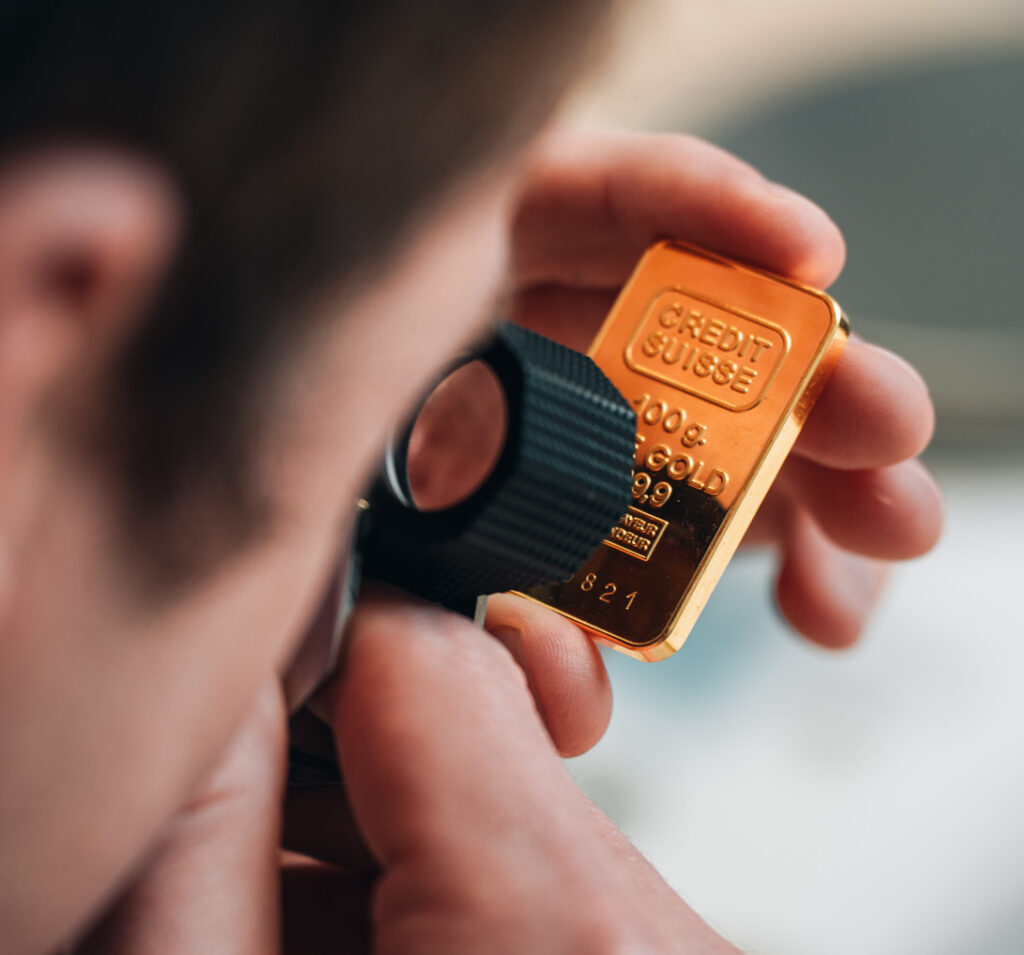
At Agence de l’Or, we provide free appraisals of your jewelry, coins, and bullion.
Our experts check:
✔ weight;
✔ purity;
✔ hallmarks;
✔ the actual composition of the metal.
We then calculate an estimate based on the official exchange rate for that day.
Get a free estimate for your gold
Would you like to know the current value of your gold jewelry, coins, or bars?
Our experts welcome you to our branches in:
Every estimate is free, transparent, and non-binding.
Key Takeaways
Gold protects your wealth during times of uncertainty.
It retains its value despite inflation.
Diversification enhances your security.
Physical gold gives you complete freedom.
Similar articles
Personalized advice at the branch
In addition to online purchases, our experts are available to meet with you at one of our branches in Belgium to help you with your investment plan: choosing the right investment vehicle, setting a budget, and developing a diversification strategy tailored to your goals.
This consultation is free and requires no commitment. Take advantage of our hands-on experience to invest with confidence, with the same level of transparency as you’d find online.
Frequently Asked Questions
Can I purchase precious metals online or only in person?
L’Agence de l’or offers you complete freedom. You can make your investment directly on our e-commerce website, or visit one of our branches in Belgium to receive in-person advice.
Do you provide certificates of authenticity with the products purchased?
Absolutely. Every bullion bar and investment coin we offer for sale is rigorously inspected and always comes with its official certificate of authenticity, guaranteeing its purity and provenance.
What documents do I need to provide to buy or sell gold?
For any financial transaction involving precious metals, the law requires an identity verification process known as KYC (Know Your Customer). Whether you’re confirming an online payment or selling an item in a store, you’ll be asked to provide a valid form of identification to ensure the transaction is secure.
Can I pick up my online order directly at the store?
Yes, if you'd prefer to avoid shipping, you can select "pick up in store" when you place your order. Your order will be prepared and made available securely at the location of your choice.