
Search
Categories
- Money News (9)
- Gold News (33)
- Platinum News (1)
- Precious Stones (4)
100% Secure Payment
Fast delivery within 24 hours*
Certified and Traceable Products
Belgian Company
Platinum, white gold, or silver: How can you tell them apart?
- November 3, 2026
- 3:59 p.m.
- Tom
- Share
A white ring, a light gray chain, or a shiny wedding band might seem easy to identify.
However, platinum, white gold, and silver can sometimes look very similar.
At first glance, it’s not always easy to tell what metal a piece of jewelry is actually made of.
And the difference is far from insignificant: their composition, density, hallmarks, and value are very different.
So, how can you tell the difference between platinum, white gold, and silver? What clues can you look for at home, and when should you have your jewelry tested by a professional?
Why do these three metals look so much alike?
Platinum is naturally white to light gray in color.
Silver also has a bright, white sheen.
Gold, on the other hand, is naturally yellow. To make white gold, gold is mixed with other metals to achieve a lighter color.
Many pieces of white gold jewelry also undergo a surface treatment—particularly rhodium plating—to achieve a particularly white and shiny appearance.
The result: When properly cared for, platinum, white gold, and silver jewelry can be difficult to distinguish from one another with the naked eye.
White gold: gold mixed with other metals
Contrary to what its name might suggest, white gold is not a different metal from yellow gold.
It is a gold-based alloy.
Pure gold is naturally yellow and relatively soft. In jewelry, it is therefore alloyed with other metals to increase its strength and alter its color.
In particular, there are various types of titration:
- 375: 9 carats, or 37.5% gold;
- 585: 14 karats, or 58.5% gold;
- 750: 18 karats, or 75% gold.
Thus, an 18-karat white gold ring contains the same proportion of fine gold as an 18-karat yellow gold ring.
Therefore, the color does not affect the amount of gold present when the titration is identical.
Why does white gold turn yellow over time?
This is a common question.
Some white gold jewelry is coated with a thin layer of rhodium to achieve a particularly white color.
Over time, this layer may gradually wear away.
The natural color of the alloy underneath may then become more visible, giving the jewelry a slightly warmer or more yellowish hue.
That doesn't automatically mean the piece of jewelry is fake.
On the contrary, this phenomenon may simply be due to normal wear and tear on the surface treatment.
What is platinum?
Platinum is a naturally white precious metal.
Unlike white gold, it does not need to be made white by adding an alloy designed to alter the color of yellow gold.
It is prized in jewelry, particularly for its durability, density, and color.
Platinum jewelry can have different finenesses, including the following common designations:
- 850 ;
- 900 ;
- 950.
A "950" hallmark generally indicates an alloy containing approximately 95% platinum.
Why does platinum jewelry often seem so heavy?
This is one of the most interesting clues.
Platinum is a particularly dense metal.
Given comparable dimensions, a piece of platinum jewelry may therefore feel significantly heavier than a piece of silver jewelry, and is often heavier than a similar piece made from certain white gold alloys.
This is particularly noticeable in:
- wedding rings;
- thick rings;
- signet rings;
- certain bracelets.
However, weight alone is not enough to confirm that a piece of jewelry is made of platinum.
The size, thickness, and construction of the piece of jewelry obviously affect its total weight.
What is money?
Silver is also a naturally light-colored precious metal.
Like gold, it is often used in the form of an alloy rather than in its pure form.
Some of the most common titles include:
- 800: 80% cash;
- 835: 83.5% silver;
- 900: 90% silver;
- 925: 92.5% silver.
925 silver is also known as sterling silver.
It is particularly common in jewelry making.
Does turning it black make it easier to recognize silver?
Silver can tarnish and turn gray or black over time.
This phenomenon is primarily due to a reaction between silver and certain compounds present in its environment.
A piece of antique silver jewelry may therefore appear much darker than a piece made of platinum or white gold.
But be careful: discoloration alone is not sufficient proof.
A silver-colored metal object can also tarnish because its surface contains silver.
On the other hand, a piece of silver jewelry that has just been cleaned can be perfectly shiny.
White gold, platinum, or silver: check the hallmarks first
Hallmarks and markings are often the first clue.
On a piece of white gold jewelry
In particular, you'll find:
375, 585, or 750
These figures represent the gold content of the alloy.
On a piece of platinum jewelry
In particular, you may encounter:
850, 900, or 950
Sometimes accompanied by other brands, depending on the manufacturer and country of origin.
On a piece of silver jewelry
Common entries include:
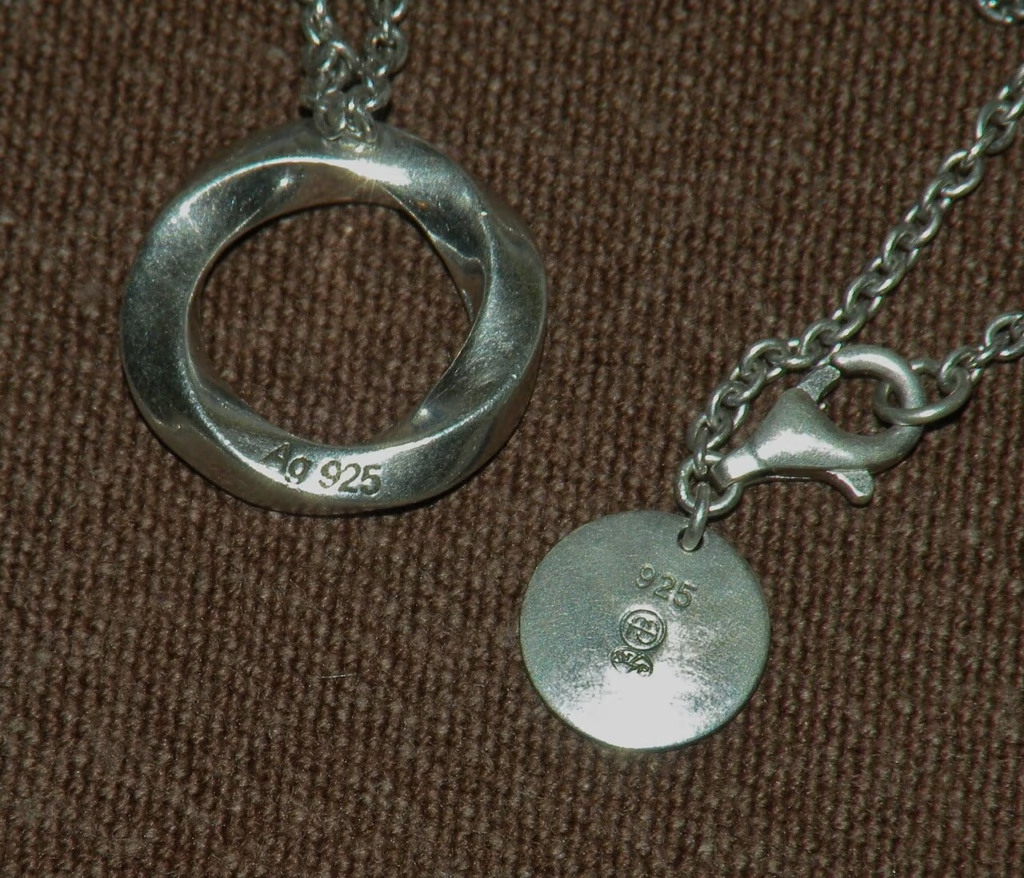
800, 835, 900, or 925
The 925 hallmark is particularly common in jewelry.
Can we rely solely on the hallmark?
No.
A hallmark is a very useful clue, but it is not always enough.
On a piece of antique jewelry, it may be:
- very small;
- worn out;
- partially erased;
- hard to read;
- located in a hard-to-reach area.
Punching systems also vary by country and era.
A piece of jewelry may therefore require additional testing to accurately determine its composition.
Can you tell these three metals apart by their color?
Not reliably.
Platinum generally has a slightly grayer, more natural hue.
Silver can be very shiny when it has just been polished.
Rhodium-plated white gold, on the other hand, can have a particularly brilliant white color.
But these differences can be very subtle.
The condition of the jewelry, its age, how it has been cared for, and any surface treatments can also affect its appearance.
Color alone, therefore, does not allow us to identify the metal with certainty.
Can weight help?
Yes, but only as a clue.
For a given volume, platinum is particularly dense.
Silver is significantly less dense.
White gold falls somewhere in between, depending on the exact composition of its alloy.
As a result, two visually similar wedding bands can feel very different in terms of weight when you hold them in your hand.
However, in order to use density as a reliable method of identification, one would need to know the exact volume and composition of the piece of jewelry.
For an individual, weight is therefore primarily an additional indicator.
What about the magnet test?
Pure gold, silver, and platinum are not metals that are strongly attracted to a conventional magnet.
A piece of jewelry with a strong magnetic field can therefore raise doubts.
But even so, this test has its limitations.
A piece of jewelry may include:
- a spring;
- a clasp;
- a mechanical part;
- or certain components made of a different metal.
A slight magnetic reaction does not necessarily mean that the entire piece of jewelry is fake.
The magnet test is primarily used to rule out certain possibilities, but it cannot, on its own, confirm the presence of a precious metal.
Why do healthcare professionals use additional tests?
When there is any doubt, various methods can be used to identify the metal and determine its purity.
Depending on the type of jewelry, the professional may, for example, examine the hallmarks, conduct appropriate tests, and compare the results.
The goal is to determine more precisely:
- the type of metal;
- its title;
- its weight;
- and its potential value.
At Agence de l’Or, jewelry is examined and weighed in front of the customer to ensure that the various steps of the appraisal process are transparent.
Platinum or white gold: which is worth more?
There is no answer that is always valid.
The value of precious metals fluctuates based on their market prices.
Therefore, one should not assume that platinum is always more valuable than gold simply because it is rare or particularly dense.
To compare two pieces of jewelry, you need to consider:
- their weight;
- their titles;
- the actual amount of precious metal;
- the price of the metal in question at the time of the estimate.
A platinum wedding band and a white gold wedding band of the same size can therefore have very different values depending on their composition and market conditions.
What about the money?
Silver generally has a value per gram that is significantly lower than that of gold and platinum.
This explains why it is particularly important to identify the metal correctly.
A ring that appears to be silver may sometimes be made of white gold or platinum.
Conversely, a piece of jewelry that looks white and very shiny is not necessarily made of white gold.
You can't judge its value by its appearance.
Can a piece of jewelry without a hallmark still be made of white gold, silver, or platinum?
Yes.
The absence of a clearly visible hallmark does not automatically mean that the piece of jewelry is not made of a precious metal.
In particular, the markings may have worn off or become difficult to read over time.
Some antique jewelry or jewelry from other countries may also have markings that differ from those we are used to.
If in doubt, the simplest thing to do is to have the jewelry tested.
Is an old white ring worth having checked?
Absolutely.
It is not uncommon for antique jewelry to be kept for years without the owner knowing exactly what metal it is made of.
A white ring may be mistaken for silver when it is actually made of white gold or platinum.
The opposite case is also possible.
Before throwing away, giving away, or selling a piece of jewelry without knowing what it's made of, it's best to have it appraised.
What kinds of jewelry can be made of platinum?
Platinum is used, in particular, to manufacture:
- alliances;
- alliances;
- engagement rings;
- certain diamond-set rings;
- signet rings;
- pendants;
- certain bracelets;
- certain pieces of fine jewelry.
It is particularly prized for jewelry intended to be worn for many years.
Some older pieces of jewelry may also be made of platinum without the owner realizing it.
How can you determine the value of a piece of white jewelry?
To truly determine its value, several pieces of information are needed:
Identify the metal
The first step is to determine whether it is silver, white gold, platinum, or possibly another metal.
Determine the titer
A piece of 750 white gold jewelry does not have the same composition as a piece of 585 gold jewelry.
Similarly, a piece of 925 silver jewelry and a piece of 950 platinum jewelry are made of completely different metals.
Weigh the jewelry
The weight is then used to determine the amount of metal present.
View the corresponding course
Finally, the value of the metal depends on its market price at the time of the appraisal.
Don't judge by appearances alone
That's probably the most important point to remember.
A very shiny white ring can be:
- silver;
- in white gold;
- platinum;
- made of silver-colored metal;
- or in another alloy.
Even for an experienced observer, reliable identification may require testing.
Before assuming that a piece of antique jewelry is of little value simply because it looks like silver, it may be worth having it appraised.
Have your white gold, silver, or platinum jewelry tested for free
Do you own a piece of white jewelry and aren't sure if it's silver, white gold, or platinum?
At Agence de l’Or, our specialists can examine your jewelry, verify its composition, and weigh it in front of you to determine its value based on the metal, fineness, and the current market price.
The estimate is free and non-binding.
You can visit one of our branches in Belgium directly:
You don't need to know the type of metal or the number of carats before your visit.
Simply bring your jewelry to one of our branches: we can test it, weigh it in front of you, and explain exactly what you have.
Key Takeaways
Gold protects your wealth during times of uncertainty.
It retains its value despite inflation.
Diversification enhances your security.
Physical gold gives you complete freedom.
Similar articles
800, 900, or 925 Silver: What Are the Differences, and Which Is Worth the Most?
Why can two pieces of gold jewelry of the same weight have different values?
Personalized advice at the branch
In addition to online purchases, our experts are available to meet with you at one of our branches in Belgium to help you with your investment plan: choosing the right investment vehicle, setting a budget, and developing a diversification strategy tailored to your goals.
This consultation is free and requires no commitment. Take advantage of our hands-on experience to invest with confidence, with the same level of transparency as you’d find online.
Frequently Asked Questions
Can I purchase precious metals online or only in person?
L’Agence de l’or offers you complete freedom. You can make your investment directly on our e-commerce website, or visit one of our branches in Belgium to receive in-person advice.
Do you provide certificates of authenticity with the products purchased?
Absolutely. Every bullion bar and investment coin we offer for sale is rigorously inspected and always comes with its official certificate of authenticity, guaranteeing its purity and provenance.
What documents do I need to provide to buy or sell gold?
For any financial transaction involving precious metals, the law requires an identity verification process known as KYC (Know Your Customer). Whether you’re confirming an online payment or selling an item in a store, you’ll be asked to provide a valid form of identification to ensure the transaction is secure.
Can I pick up my online order directly at the store?
Yes, if you'd prefer to avoid shipping, you can select "pick up in store" when you place your order. Your order will be prepared and made available securely at the location of your choice.